
The McKinsey AI Interview is emerging as a new component in some final round interviews, adding a new dimension to how the firm evaluates consulting talent. It does not replace core MBB case interview prep, which still decides most outcomes. Based on information gathered by CaseBasix from internal sources, some candidates may be asked to collaborate with an internal AI tool as part of the McKinsey final round AI interview. This development reflects how AI is becoming more embedded in real consulting work and what McKinsey increasingly expects from future consultants.
In this article, we will explore what the McKinsey AI Interview is, how it fits into the interview process, what skills are assessed, and how you can prepare without overcomplicating your overall interview strategy.
TL;DR – What You Need to Know
The McKinsey AI Interview evaluates how candidates apply structured thinking and judgment while collaborating with AI during the final interview stage.
- The AI interview may appear alongside the case interview and Personal Experience Interview as an additional final round assessment in the US and North America.
- Candidates are assessed on judgment, structure, iteration, and communication when the AI interview appears, not on technical knowledge or advanced prompt engineering.
- Preparation should focus on applying consulting fundamentals in an AI supported setting, with case interviews and PEI remaining the primary hiring drivers.
- Common mistakes include over relying on AI output, weak problem framing, and poor explanation of reasoning.
- The AI interview signals a broader shift toward AI supported consulting work, while core consulting skills remain essential.
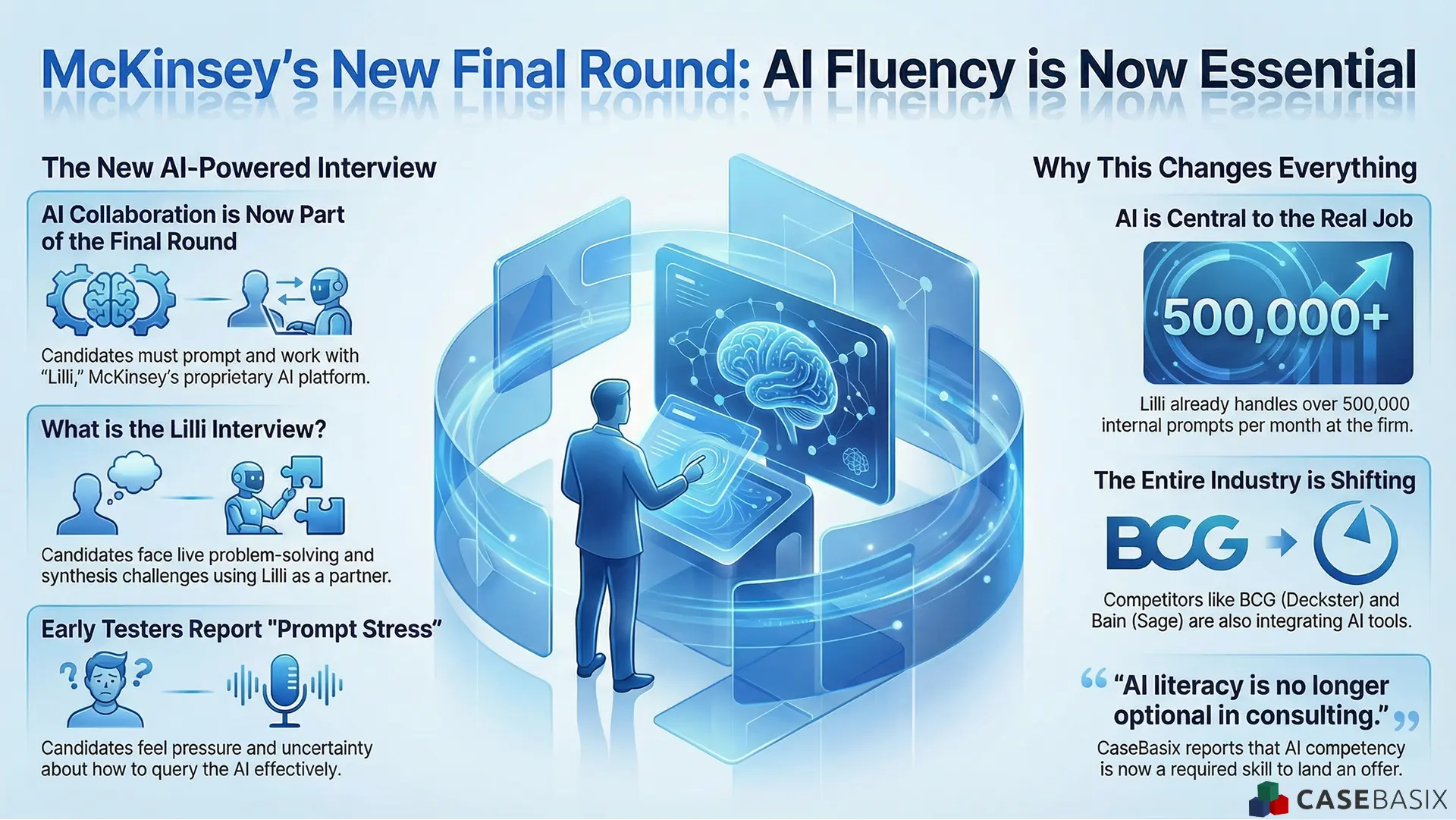
Overview of how the McKinsey AI Interview fits into the final round and what candidates are evaluated on.
Where the McKinsey AI Interview Fits in the Final Round
CaseBasix has learned through early reporting that the McKinsey AI Interview has appeared in some final round processes as an additional interview alongside the case interview and the Personal Experience Interview. Everything else about the McKinsey final round interview stays the same, including the partner led cases and PEI. McKinsey has not launched the AI interview globally, and current indications suggest it applies only to select final rounds in parts of the United States. In this setup, the McKinsey AI Interview complements existing assessments by evaluating how candidates work with AI in realistic consulting tasks rather than replacing traditional problem solving or leadership evaluation.
In the final round, candidates typically complete multiple interviews that test different capabilities. In some cases, the McKinsey final round AI interview is included as a separate component next to the case interview and PEI.
You can think of the structure in simple terms:
- One interview focused on case problem solving and structured thinking
- One interview focused on personal impact, leadership, and values
- One interview focused on collaboration with an AI tool in a consulting context
The presence of an AI interview does not change the fundamentals of the process. Strong case performance and a solid Personal Experience Interview remain essential to receiving an offer.
From an evaluation perspective, the AI interview acts as an additional signal. It helps interviewers understand whether you can apply judgment, structure, and clarity when using AI tools similar to those used in real project work. The AI interview is a final layer in the process, not the primary gatekeeper.
If you are preparing for McKinsey interviews, the key takeaway is sequencing. You must first demonstrate consulting fundamentals before the AI component becomes relevant. The AI interview is a final layer, not the core gatekeeper.
How the McKinsey AI Interview Works in Practice
The McKinsey AI Interview asks candidates to complete practical consulting tasks by interacting with an internal AI tool during the interview. In the McKinsey AI Interview, you are expected to prompt the AI, review its output, and apply judgment to produce a clear and structured response. The focus is on collaboration and reasoning rather than technical AI expertise.
In practice, candidates are typically given a business question or scenario similar to real consulting work. Instead of relying only on their own analysis, they use the AI as a support tool to explore information, structure thinking, and refine insights.
This interaction usually involves:
- Asking the AI clear and focused questions related to the problem
- Reviewing the AI output for relevance, accuracy, and gaps
- Refining or re prompting when the first response is not sufficient
- Synthesizing information into a structured answer
The interviewer observes not only what the AI produces, but how the candidate works with it. Simply accepting outputs at face value is not the goal. Candidates are expected to demonstrate judgment, structure, and decision making.
The interaction is live and time bound, similar to other final round interviews. Candidates are not expected to know advanced prompting techniques. What matters is whether they can use the AI as a productive thinking partner and communicate their reasoning clearly, similar to how consultants work with junior team members on real engagements.
Kickstart Your Consulting Prep Journey?
Click the image below to get your free Consulting Starter Pack
.png)
What McKinsey Is Evaluating in the AI Interview
Based on early reporting and candidate feedback, the McKinsey AI Interview appears to assess how candidates think, judge, and collaborate with an AI tool rather than their technical AI knowledge. The McKinsey AI interview process focuses on structured reasoning, iterative improvement, and sound decision making under time pressure, reflecting how consultants are expected to work with AI in real engagements.
At a high level, McKinsey is evaluating whether candidates can use AI as a productive support tool while maintaining ownership of the final answer.
Key capabilities typically assessed include:
- Judgment when reviewing AI output, including what to use, adjust, or discard
- Structured thinking when framing questions and synthesizing response
- Iteration, shown by refining prompts and improving outputs step by step
- Clear communication when explaining reasoning and next steps
The AI interview is not a test of advanced prompting techniques. Interviewers are looking for consulting fundamentals applied in an AI supported setting.
Strong candidates show that they can stay calm, apply logic, and make sound decisions even when the AI response is incomplete or imperfect. This mirrors real consulting work, where AI supports analysis but does not replace professional judgment.
Why McKinsey Added an AI Interview
Based on CaseBasix analysis and early signals from the recruiting process, the McKinsey AI Interview appears designed to reflect how consulting work is evolving as AI becomes embedded in everyday problem solving, research, and synthesis. Testing AI collaboration in hiring helps assess whether candidates can apply judgment, structure, and professional reasoning while working with AI tools in realistic consulting situations.
In discussions about its internal AI capabilities, McKinsey has referenced platforms such as Lilli, which consultants use to support research, synthesis, and knowledge access across engagements.
In recent years, McKinsey has discussed how internal AI platforms support consultants by accelerating research, organizing knowledge, and improving synthesis across engagements. These tools are designed to augment thinking, not replace it.
From a hiring perspective, this creates a new expectation. Consultants are no longer evaluated only on how they analyze problems independently, but also on how they work with advanced tools responsibly.
The AI interview allows McKinsey to observe whether candidates can:
- Use AI to support structured thinking rather than bypass it
- Apply judgment when AI outputs are incomplete or imperfect
- Maintain ownership of decisions instead of deferring to technology
- Communicate reasoning clearly in an AI supported workflow
This approach mirrors real project environments, where consultants are expected to balance speed, rigor, and accountability. As with many recruiting innovations, the exact format and rollout of AI based interviews may vary by office, role, and hiring cycle.
How to Prepare for the McKinsey AI Interview
Before preparing, candidates should first confirm with their recruiter whether the McKinsey AI Interview is part of their final round, as it has not been rolled out universally. Most candidates will still spend the bulk of their time on the McKinsey first round interview, which remains the main hurdle. If it does appear, a focused preparation approach should be planned.
Preparing for the McKinsey AI Interview requires building comfort with structured thinking and judgment while working with an AI tool, not learning advanced prompting techniques. Candidates do not have access to McKinsey’s internal AI platforms, but can use publicly available AI tools to practice clear prompting, iterative refinement, and structured reasoning. The goal is to demonstrate that you can collaborate with AI in a professional consulting context, apply judgment to its output, and communicate clear decisions under time pressure.
You do not need a long or technical preparation plan. A short and focused approach is sufficient if your core interview fundamentals are already strong.
A practical way to prepare is to focus on how consultants actually use AI in day to day work:
- Practice asking clear, goal driven questions related to a business problem
- Review AI outputs critically rather than accepting them at face value
- Refine questions when answers are vague, incomplete, or unfocused
- Summarize insights into a simple and logical structure
You should also practice explaining your thinking out loud. Interviewers care about why you used a certain prompt, how you evaluated the response, and what you would do next if more time were available.
Most importantly, do not over optimize for the AI interview. Strong case performance and a solid Personal Experience Interview remain the foundation of success. AI preparation should be a light layer that ensures the tool feels familiar, not the center of your interview strategy.
Common Mistakes Candidates Make in the AI Interview
In the McKinsey AI interview assessment, candidates most often struggle by misusing AI rather than lacking technical ability. Common mistakes include over relying on AI output, asking unclear questions, and failing to apply judgment. These issues signal weak consulting fundamentals rather than poor AI skills.
One frequent pitfall is treating the AI as an answer engine instead of a support tool. Simply accepting outputs without questioning assumptions or gaps suggests a lack of ownership over the final recommendation.
Other common mistakes include:
- Asking vague or unfocused prompts that produce generic answers
- Failing to refine questions when the first response is incomplete
- Over correcting or over prompting instead of stepping back to structure the problem
- Presenting AI output directly without synthesis or prioritization
Another issue is weak communication. Some candidates struggle to explain why they used a specific prompt, what they trusted or ignored in the output, or what they would do next. This makes it difficult for interviewers to assess judgment and decision making.
Avoiding these mistakes does not require advanced preparation. It requires applying the same discipline used in case interviews: clear problem framing, logical evaluation, and confident explanation of your thinking.
What the McKinsey AI Interview Signals for Consulting Careers
The McKinsey AI Interview signals a broader shift in consulting careers toward applying human judgment and structured thinking alongside AI supported workflows. Delivery focused roles assessed through the McKinsey Implementation Interview are feeling the same pull. As AI becomes more integrated into consulting workflows, firms are increasingly interested in candidates who can think critically, apply structure, and take ownership of decisions while using advanced tools responsibly.
For consulting careers, this reflects a gradual change rather than a sudden overhaul. Core skills such as structured thinking, clear communication, and sound judgment remain central. What is evolving is the environment in which those skills are applied.
Looking ahead, candidates entering consulting can expect that:
- AI will increasingly support research, analysis, and synthesis work
- Consultants will be expected to evaluate and refine AI output rather than accept it blindly
- Clear explanation of reasoning will matter as much as speed or efficiency
- Professional accountability will remain with the consultant, not the tool
This shift also affects how candidates should think about preparation and career development. Learning to work productively with AI is becoming part of professional readiness, similar to learning how to build slides, structure analyses, or communicate recommendations.
At the same time, traditional consulting fundamentals are not being replaced. The McKinsey AI Interview highlights an evolution in how consulting work is done, not a departure from the skills that have always defined strong consultants.
Frequently Asked Questions
Q: Will I get the McKinsey AI Interview?
A: The McKinsey AI Interview has not been rolled out universally and appears only in some final round processes. Candidates should confirm directly with their recruiter whether it applies to their interview.
Q: Is McKinsey testing AI skills in Round 1 interviews?
A: Based on early reporting, McKinsey’s AI interview is being tested in later interview stages rather than in initial screening or first round interviews. This may change as the process evolves.
Q: What is tested in the McKinsey AI interview?
A: The McKinsey AI interview tests how candidates apply judgment, structure, and clear reasoning while working with an AI tool. Interviewers focus on how candidates frame questions, evaluate AI output, refine ideas, and explain decisions rather than on technical AI knowledge.
Q: How should candidates prepare for the McKinsey AI interview?
A: Candidates should prepare by ensuring AI tools feel familiar and by practicing structured thinking with AI support. Core case interview and Personal Experience Interview performance should remain the primary focus.
Q: Is the McKinsey AI interview focused on prompt engineering?
A: The McKinsey AI interview is not focused on prompt engineering. Candidates are evaluated on judgment, clarity, and structured thinking when using AI rather than on technical commands or advanced prompting techniques.
Q: Can AI skills replace case interview performance at McKinsey?
A: No. AI skills do not replace case interview performance at McKinsey. Structured problem solving and leadership assessment remain central to hiring decisions, with the AI interview serving only as an additional signal.
Your Prep Journey
Not sure where to start? Get a personalized consulting prep plan based on your background and target firms.



